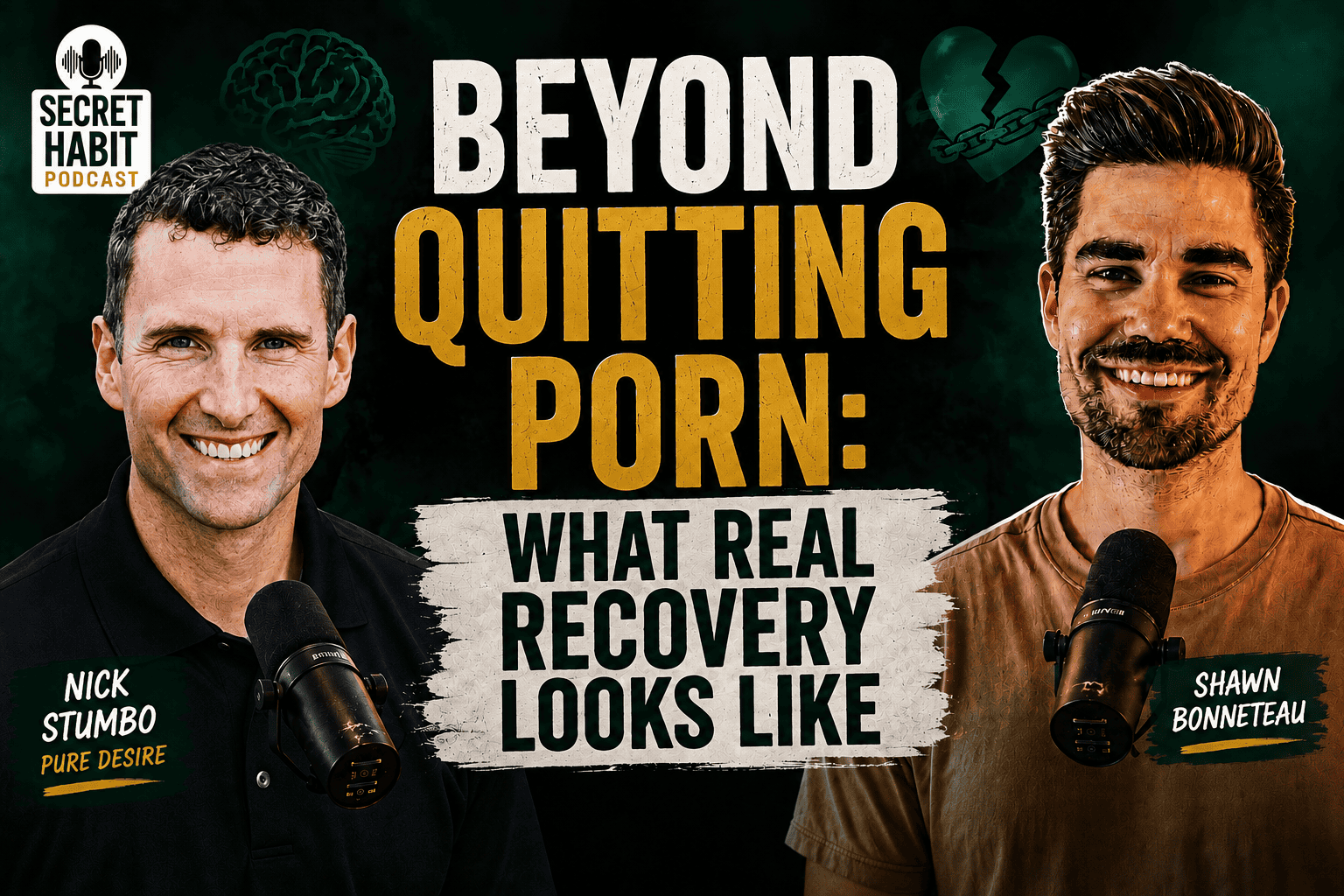
Nick Stumbo of Pure Desire explains why recovery requires more than trying harder, and why having a personal plan, supportive community, and experienced help can change everything.
Relapse Prevention Starts Before the Temptation
One of the biggest mistakes I see men make in porn recovery is waiting until they are in the middle of temptation to figure out what they are going to do. By that point, they may already be stressed, lonely, discouraged, triggered, disconnected, or simply looking for relief. They are trying to make a good decision while they are already overwhelmed.
That is one of the reasons I was so encouraged by my conversation with Nick Stumbo of Pure Desire. Nick has spent years helping men walk through sexual addiction recovery, both individually and through church-based groups, and one of the things he kept coming back to was the importance of having a plan. Not simply a commitment to do better next time, but an actual recovery plan that helps a man understand what is happening, recognize where he is headed, and know what to do.
Nick's point is simple but powerful: recovery gets much more practical when you stop treating relapse like a completely unexpected event. If you know your patterns, your vulnerabilities, your triggers, and the steps you need to take when you are moving toward a relapse, you have something to work with. You are no longer depending entirely on how motivated you happen to feel in the moment.
This connects deeply with the way I coach men. I want guys to become clear about their inner world… aka their Red Zone. The place where they become more vulnerable to escape. The goal is not to become a man who is never triggered. The goal is to become a man who understands what is happening when he is triggered and knows what to do next.
Learn more about what's really going beneath your struggles and what to do about it
You Need a Plan Before You Need Willpower
A lot of men have what they think is a recovery plan, but when you ask them what they are actually going to do when temptation hits, the plan becomes pretty vague. Maybe they will pray. Maybe they will call somebody. Maybe they will get off their phone. Maybe they will try harder. Those things can all be useful, but they are not the same thing as having a clear, personalized strategy.
Nick's approach challenged this idea in a practical way. A man needs to understand the pathway that leads him toward a relapse and have something concrete to do when he recognizes that pathway. The work is not simply about saying no to porn. It is about becoming increasingly aware of what is happening before the behavior and having a response ready.
That raises much better questions: What happens inside me before I reach for porn? What circumstances make me more vulnerable? What does my Red Zone actually look like? What does my Green Zone look like? What do I do when I notice myself moving toward escape? Who do I reach out to? What needs to change in my environment? And underneath all of that, what is my heart actually hungry for?
This is where clarity becomes incredibly practical. You cannot build a strategy around a problem you do not understand. The more clearly you understand your own patterns, the more specifically you can respond to them.
That is what I heard Nick emphasizing throughout our conversation. He was not giving men another motivational speech about trying harder. He was talking about the value of knowing your patterns, building a plan, and putting support around yourself so that recovery becomes something you actually practice.
Get full access to tons of great tools from Nick and the Pure Desire team
What Nick Stumbo Taught Me About Clarity
One of the things I appreciated most about this conversation was how strongly Nick emphasized clarity. He has seen men who genuinely want freedom but still do not have a clear picture of what they need to do next. They may know they have a problem. They may know pornography is damaging their lives. They may even know many of the principles of recovery. But knowing that something is wrong is not the same as knowing how to move forward.
That distinction matters. A man can be sincere and still be stuck. He can love Jesus, want freedom, pray regularly, and have years of effort behind him, while still lacking a strategy that fits his actual story.
Nick's work points toward a much more hopeful way of looking at this. Instead of seeing a relapse or repeated struggle as proof that a man cannot change, you can begin asking what the struggle is revealing. What happened before it? What was he experiencing? What did he need? What did he do next? What could have interrupted that sequence? What does he need to learn from it?
That kind of curiosity creates clarity. And clarity gives you something you can actually work with.
Do you need some help getting this sort of clarity?
Don't Recover Alone
Another major theme of my conversation with Nick was community. He has a deep passion for men not trying to walk through sexual addiction recovery by themselves, and that is one of the things Pure Desire has become known for. Their model has helped churches create structured environments where men can be honest about their struggles, receive support, and walk through recovery with other people who understand the journey.
I think this matters enormously. Shame thrives in isolation. When everything stays inside your own head, it is easy to believe you are uniquely broken, uniquely stuck, or somehow beyond help. Bringing your struggle into the light changes that.
Learn more about Pure Desire Groups
But I also think there is an important distinction between community and personalized guidance. A group can give you belonging, honesty, encouragement, and accountability. Those things are incredibly valuable. But sometimes you also need someone who can sit down with you and understand your particular story well enough to help you see what you cannot see on your own.
You may need someone to help you connect the dots between your patterns, your inner world, your wounds, your heart hunger, and the practical strategy you need moving forward. That is where working with an experienced coach, counselor, or recovery leader can become incredibly valuable.
Nick's passion for community and my passion for personalized coaching are not competing ideas. In many cases, they can complement each other. You can have men around you while also having someone helping you understand your specific situation and build a strategy around it.
Why a Personal Recovery Plan Changes the Question
For years, many men have asked themselves the same question: How do I stop watching porn? It is understandable. The behavior is painful, destructive, and often deeply frustrating. Of course you want it to stop.
But I believe there is a better question underneath that question: What is actually happening in my heart?
That question opens up a completely different kind of recovery. Instead of only fighting the behavior, you start looking at what the behavior is connected to. What is happening in your inner world? What is your heart hungry for? What patterns have developed? What are you believing? What are you using porn or other forms of escape to accomplish?
This is why I created the Clarity Quiz. It is not designed to diagnose you or put you in a box. It is designed to help you begin seeing what your heart may actually be hungry for.
And once you have that clarity, the next question becomes: What do I do with it?
That is where a Personal Recovery Plan becomes so valuable. You take the awareness you have begun developing and turn it into a practical strategy. You stop collecting information and start deciding what actually applies to you.
Confusion → Clarity → Confidence → Freedom
This is the progression I keep coming back to in my coaching: confusion, clarity, confidence, freedom.
When a man is confused, everything feels complicated. He is trying different things, reacting to different situations, and wondering why something that seems so simple for other people feels so difficult for him.
Clarity changes that. When you understand what is actually happening, you can make better decisions. You can identify your Red Zone. You can build your Green Zone. You can recognize your heart's hunger. You can identify the patterns that keep pulling you toward escape.
Then you can build a strategy. And when you know what to do, you begin to grow in confidence. You stop guessing. You stop reinventing your recovery every time you get triggered. You begin practicing the same principles again and again until they become part of how you live.
That is what I mean by freedom. Not perfection. Not a life where you never struggle again. A life where you know what is true, you know what to do, and you know how to return to maturity when you get knocked off course.
What To Do When You Relapse
Nick's approach also helped reinforce something important: a relapse does not have to become the end of the recovery process. It can become data.
That does not mean minimizing sin or pretending the consequences do not matter. It means refusing to waste the opportunity to learn. Instead of immediately moving into shame, secrecy, and self-condemnation, a man can slow down and ask what happened.
What was happening before the behavior? What circumstances were present? What was I feeling? What was I thinking? What was I hungry for? Where did I stop paying attention? What did I ignore? What could I have done differently? Who could I have reached out to?
The answers become information for the plan. Maybe the man needs to strengthen his Green Zone. Maybe he needs to recognize his Red Zone earlier. Maybe he needs more community. Maybe he needs to address a wound. Maybe he needs to change a practical part of his environment. Maybe he needs someone experienced to help him understand a pattern he cannot see.
This is why I want men to stop seeing recovery as a pass-or-fail test. Recovery is a process of learning to live differently. The goal is not to pretend temptation will disappear. The goal is to become increasingly prepared to respond to it.
The Difference Between Knowing What To Do and Having a Strategy
If you have been working on this for years, there is a good chance you already know a lot. You may know Scripture. You may understand the neuroscience. You may have read books, listened to podcasts, joined accountability groups, prayed, confessed, and tried to change your habits.
That knowledge matters. But knowing what you are supposed to do and having a recovery strategy that actually fits your story are two different things.
A strategy answers the question, What does this look like for me?
It takes the principles you have learned and connects them to your actual life. Your actual triggers. Your actual relationships. Your actual heart hunger. Your actual Red Zone. Your actual Green Zone.
That is why I am so passionate about coaching. I do not want to impress men with how much information I can give them. I want to understand them well enough to help them build something they can actually live.
Tune into the Secret Habit podcast for more content on these topics
Building Your Personal Recovery Plan
This is exactly what we do in a Personal Recovery Plan Session.
We sit down together and get clear. We look at what is really driving your struggle, the patterns you may be missing, what your heart is hungry for, where your blind spots are, what your Red Zone looks like, what your Green Zone needs to look like, and what your next steps should be.
The goal is not for you to leave with another giant pile of information. The goal is for you to leave knowing what to do and why it works.
You leave with clarity, confidence, and a practical recovery strategy built around your story.
Book your personal recovery plan session
For some men, that session gives them exactly what they need to move forward on their own. For others, it becomes the foundation for ongoing coaching and support. Either way, the purpose is the same: stop guessing and start recovering with clarity.
Resources From Nick Stumbo and Pure Desire
If you are looking for a structured Christian recovery environment, I genuinely encourage you to explore Pure Desire. Nick's work builds on the legacy of Ted Roberts and the broader Pure Desire approach to helping men, churches, and families address sexual addiction with honesty, community, and practical recovery tools.
Hope, Healing and Freedom Book
One of the things I appreciate about Pure Desire is that the message is not simply, Try harder and be a better Christian. There is an emphasis on bringing the struggle into the light, understanding what is happening, walking with other people, and putting practical tools around the recovery process.
If a group environment is what you need, explore their groups and resources. If you are looking for individualized clarity and a personalized strategy, that is where my Personal Recovery Plan may be the better next step for you.
You Don't Have to Figure This Out Alone
If there is one thing I hope you take away from my conversation with Nick, it is this: you do not have to figure this out alone, and you do not have to keep guessing.
You may not need another promise that this time you are finally going to try harder. You may need to understand what keeps happening. You may need a plan. You may need community. You may need an experienced person to help you see what you cannot see by yourself.
And you may need all three.
Nick's work through Pure Desire is one valuable path for men who want structured Christian community and recovery support. If that sounds like what you need, I encourage you to explore it.
And if you are ready to sit down with me and build a strategy specifically around your story, start with the Clarity Quiz or book a Personal Recovery Plan Session.
Build your own personal recovery plan with Shawn
You can also listen to the full conversation with Nick Stumbo, where we go much deeper into his experience, Pure Desire, recovery groups, relapse prevention, and what it actually takes to build a path forward.
Listen to the podcst on Apple Podcast here
You do not have to know exactly what your next step is before you take it. Sometimes the next step is simply getting clear. From there, you can build the strategy, gain the confidence, and begin moving toward the freedom you have been looking for.